Moon Calendar: How to use

How to use the Moon's gravity to benefit plants? In this article, you will learn how different lunar aspects influence plants, and at the end of the article, you will find practical tips.
Download Moon Growing Calendar 2026
It will help you determine the best days for planting, germination, transplanting, fertilizing, pruning, training, harvesting, and pest control. Calendar is in English.
- Moon_Growing_Calendar_GROWSHOP_BALTIC_2026_A3.pdf — for printing, 2 pages А3
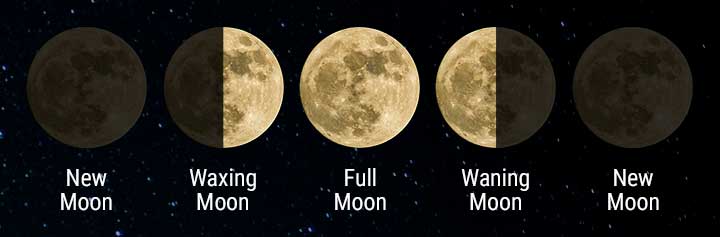
Moon Phases
🌑 New Moon
When the Moon is not visible (its dark side faces the Earth).
- It is not recommended to work with plants.
- You can prune dry or diseased branches.
🌓 Waxing Moon
When the right side of the Moon becomes visible and gradually emerges from the shadow. The internal activity of plants increases, as does their resistance to pests and diseases.
- Pruning is not recommended.
🌕 Full Moon
When the Moon is fully illuminated. Plant sap rises to the above-ground parts.
- An ideal moment for germinating seeds.
- Pruning is not recommended.
🌗 Waning Moon
When the right side of the Moon gradually sinks into the shadow. Plant sap descends to the underground parts, and the soil becomes more workable.
- An ideal time for watering and fertilizing.
- Also recommended for harvesting, as beneficial substances and aromas are better preserved during this period.
- Sowing, planting, and transplanting are not recommended.
Moon Cycles (not to be confused with Phases!)
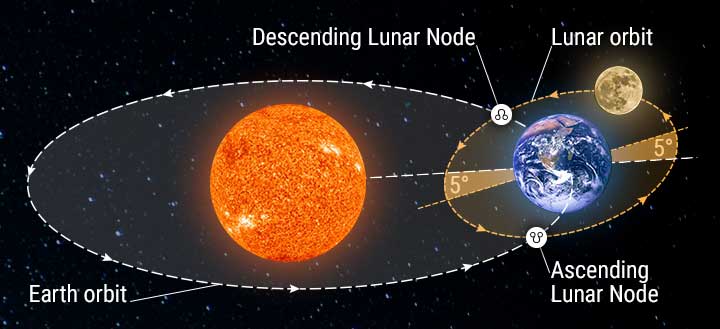
Every day, the Moon's trajectory changes slightly. Over 13–14 days, the Moon rises higher (ascending Moon), reaches its peak, and then over the following 13–14 days, it descends (descending Moon). These two periods together total 27.3 Earth days, during which the Moon completes a full orbit around the Earth.
Throughout the year, the Earth orbits the Sun along the ecliptic path. The Moon's orbit is inclined at a 5° angle to the ecliptic — the Moon either rises above the ecliptic (ascending cycle) or descends below it (descending cycle).
Ascending Moon
Fluids in plants rise; nutrients are directed to the upper parts.
- An ideal moment for cutting and preparing clones.
- Avoid harvesting if you plan to dry the yield.
Descending Moon
Fluids in plants descend, increasing the activity of underground parts — the descending Moon seems to "pull" the lower parts of the plant into the soil.
- The best time for planting and germinating seeds, stimulating roots, and enriching the soil.
What affects more — the phase of the Moon or its cycle?
It depends on the geographical latitude. The closer to the pole, the greater the influence of the cycle (ascending or descending) — as in Europe. The closer to the equator, the stronger the influence of the Moon's phase (waxing or waning).
Tidal Effects
Every day, there are two high tides and two low tides on the Earth's surface — they replace each other approximately every 6 hours.
- The morning high tide has a stronger effect than the daytime one.
- The daytime low tide has a stronger effect than the morning one.
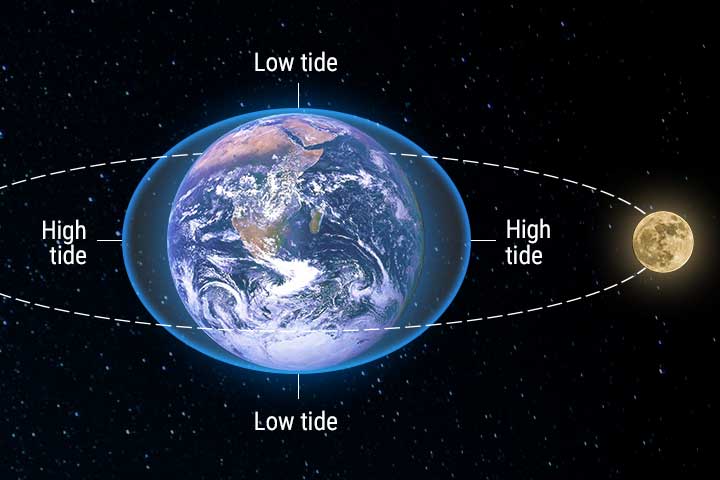
The Sun's Gravity
The Sun's gravity also noticeably influences tidal waves, but it is about two times weaker than the Moon's pull.
- During the new moon and full moon, tides are higher — the tidal forces of the Sun and Moon are aligned.
- During the first and third quarters, the tidal range decreases — the forces of the Sun and Moon oppose each other.
Recommendations
- During high tide on a 🌗 waning Moon, it is recommended to graft cuttings, work the soil, prepare compost, or harvest.
- During low tide, it is recommended to sow (if the Moon is é ascending), transplant, work with loose soil, and apply fertilizers.
Important! In the calendar, the tide schedule is calculated for the eastern part of the Baltic Sea and the UTC +2 time zone.
Elements and Zodiac signs
Some consider the position of the Moon in the Zodiac to be an important factor when working with plants. The lunar month is divided into 12 sectors along the ecliptic, each of which lasts approximately two days, and each sector is named after the corresponding constellation.
The position of the Moon in each of these 12 constellations has its own effect on plants. In addition, these constellations are united into “influence groups” according to the elements — Fire, Air, Water and Earth. Each element stimulates certain biodynamic processes in plants, thus affecting different parts of the plant.
Elements
Element of Fire (Seeds and Fruits) — ♈ Aries, ♌ Leo and ♐ Sagittarius. The time when the Moon passes through these signs is considered the best for sowing seeds and developing the fruiting parts of plants.
Air Element (Flowers) — ♊ Gemini, ♎ Libra and ♒ Aquarius. This period is ideal for the development of flowers and various work on planting and caring for plants.
Element of Water (Leaves) — ♋ Cancer, ♏ Scorpio and ♓ Pisces. At this time, leaves, stems and branches are in active growth, which makes it suitable for planting and caring for the above-ground parts of plants.
Earth element (Roots) — ♉ Taurus, ♍ Virgo and ♑ Capricorn. This is the best time for all types of root work, including strengthening the root system and getting rid of unhealthy roots.
Zodiac Signs
| ♈ | Aries | Fruits | é | Ascending Moon |
| ♉ | Taurus | Roots | é | Ascending Moon |
| ♊ | Gemini | Flowers | ê | Descending Moon |
| ♋ | Cancer | Leaves | ê | Descending Moon |
| ♌ | Leo | Fruits | ê | Descending Moon |
| ♍ | Virgo | Roots | ê | Descending Moon |
| ♎ | Libra | Flowers | ê | Descending Moon |
| ♏ | Scorpio | Leaves | ê | Descending Moon |
| ♐ | Sagittarius | Fruits | é | Ascending Moon |
| ♑ | Capricorn | Roots | é | Ascending Moon |
| ♒ | Aquarius | Flowers | é | Ascending Moon |
| ♓ | Pisces | Leaves | é | Ascending Moon |
Useful tips: how to use Moon Growing Calendar
Substrate preparation
Especially relevant for outdoors. It is important to prepare the substrate during the descending Moon, in the waning phase (between the 4th day after the full moon and the new moon), in the earthly sign of the Zodiac (Taurus, Virgo or Capricorn).
Germination
For optimal development of crops, germination is recommended to be carried out on the descending Moon, approximately 3 days before the full moon. It is also recommended to combine the phases of the moon with the earth sign.
Transplantation
Transplantation is stressful for plants, so it is important to choose a favorable moment. It is recommended to choose a moment when the Moon is descending, but in the waxing phase (between the new moon and the full moon), in an air sign (Gemini, Libra or Aquarius).
Root and foliar fertilizing
Spraying fertilizers on the leaves is best done with the rising Moon in the waxing phase in water signs (Cancer, Scorpio, Pisces). When root feeding — with the descending Moon also in the waxing phase, in earth or air signs. It is more effective to apply fertilizer in the morning than in the afternoon, and avoid fire signs (Aries, Leo, Sagittarius).
Pruning
For pruning plants, it is recommended to choose a descending Moon in its waning phase and an air sign. When pruning roots, it is better to choose an earth sign.
Clone cutting
The best time to cut clones is when the Moon is rising in air signs, in its waxing or waning phase.
Planting clones
Seedlings should be planted in fire signs on the descending Moon in the waxing phase.
Branch staking or LST (Low Stress Training)
To minimize stress when tying up plant branches, it is recommended to choose the rising Moon in the waxing phase: at veg — in water signs, and at flowering — in air signs.
Insecticides and fungicides
Spraying insecticides on the leaves should be done by the rising Moon in water signs, preferably in the waxing phase. Insecticides are best applied in the morning, and fungicides in the afternoon. Preparations for root application are more effective when used on the descending Moon in the waning phase in earth signs.
Harvesting
The ideal moment for harvesting is the descending Moon in its waning phase in air signs. It is preferable to collect in the morning and during low tide to remove as much moisture as possible from the inflorescences.
In Conclusion
The decision to trust the Lunar calendar is a personal choice. It is important to remember that the Lunar calendar provides only recommendations, and decisions should be based on common sense and practical experience. Lunar calendar advice does not guarantee an ideal result, because it is just one of the tools for successful cultivation. May your harvest be rich and inspiring!

Leave a comment